
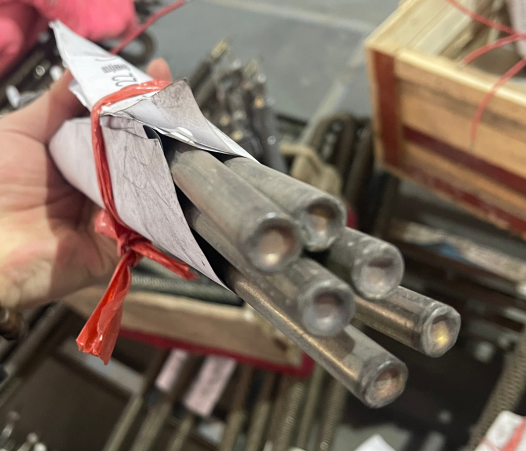
As a core component in industrial thermal systems, the reliability of single-head (cartridge) heaters directly impacts operational safety and equipment efficiency. Substandard heaters frequently result in severe failures, including unplanned downtime, safety hazards, and substantial economic losses. Based on field application data and engineering analysis, this report identifies the primary failure mechanisms and root causes for cartridge heaters.
Heater performance is fundamentally determined by material selection and quality. A high-performance cartridge heater integrates more than ten precision materials; weakness in any single component can lead to complete heater failure.
A. Sheath Material (External Housing)
Stainless steel exhibits surface oxidation at elevated temperatures. Minor discoloration is normal, but low-grade alloys accelerate oxidation, leading to surface scaling, wall thinning, and premature failure.For high-temperature applications, Incoloy 800 or Incoloy 840 is strongly recommended to deliver superior oxidation resistance and long-term structural stability.
B. Resistance Wire (Heating Element)
Internal resistance wires must sustain severe electrical and thermal cycling loads. Inferior or impure alloys oxidize rapidly at high temperatures, resulting in early embrittlement and open-circuit failure.High-precision nickelchromium (Ni-Cr) alloys preserve mechanical strength and stable electrical resistance under continuous peak-temperature operation.
C. Magnesium Oxide (MgO) Insulation
Magnesium oxide acts as both electrical insulation and thermal conduction medium between the resistance wire and the outer sheath. High-purity, modified MgO delivers maximum thermal conductivity while maintaining excellent insulation resistance to prevent leakage and electrical breakdown.
Incorrect installation clearance is one of the most frequent causes of localized overheating and heater burnout.Excessive clearance between the heater and mounting hole creates an air gap. Since air is a poor thermal conductor, this gap introduces high thermal resistance, forcing internal heater temperatures to rise far beyond design limits to compensate for poor heat transfer.For high watt-density cartridge heaters, diameter tolerance should be controlled within ±0.02 mm. Total diametral clearance should be less than 0.1 mm (single-side gap < 0.05 mm). For example, a 10 mm diameter heater should be installed in a 10.1 mm maximum bore.
Correct alignment between the heated length and the mounting hole is critical.If the heated zone is exposed to air rather than fully embedded in the mold, heat dissipation fails, causing the heater to glow red, deform, or create fire hazards.If insertion depth is excessive, the terminal lead area and sealing section may enter the mold’s high-temperature zone, causing insulation carbonization and short circuits.Users must strictly match the heater’s rated heated length to the effective depth of the mounting hole.
Magnesium oxide is inherently hygroscopic and readily absorbs moisture from the air.In humid environments or with damaged terminal seals, moisture penetrates the MgO layer, causing a sharp decline in insulation resistance and electrical breakdown during startup.Although moisture can be evaporated during operation, initial coldstate leakage presents serious safety risks. In high-humidity environments, a low-voltage soft start (50% rated voltage) is recommended to gradually remove moisture before full power is applied.
Heater power follows the relationship:P = V² / R If a 220V heater is incorrectly connected to 380V power, the output power increases nearly threefold. This extreme watt density surge exceeds the heat dissipation capacity of the assembly, causing instantaneous melting of the internal heating element.Higher power ratings require correspondingly improved heat dissipation conditions. If the application cannot remove heat as quickly as the heater generates it, internal core temperatures will exceed material thermal limits, drastically reducing service life.
The selection of a cartridge heater represents a critical investment in long-term equipment reliability. By implementing high-quality materials, precision fitment, and correct electrical configuration, users can maximize heater service life and ensure safe, stable industrial operation. For customized thermal solutions and professional technical support, please contact our engineering team.